Command and Control

The Titan II intercontinental ballistic missile was one of the deadliest weapons ever created. It was over a hundred feet tall, but you wouldn’t have seen one standing on a launch pad during its heyday because they were kept in underground silos, poised to launch at the press of a button (or the turn of a couple of keys, or however that worked). It could reach the edge of space in five minutes, and the heart of Soviet Russia in twenty, carrying a nuclear warhead more powerful than the combined force of all of the bombs dropped during all of World War II, including the two atomic bombs dropped on Hiroshima and Nagasaki.

The Titan II rocket was created in the early 1960s but really should have been retired by the late 1970s. Some claim that the main reason they were still kept at the ready in 1980 is that they were to be used as bargaining chips in the de-escalation talks—we’ll get rid of ours if you get rid of yours. But nonetheless, they were still around and still operational, so they required regular maintenance. And that’s how a small team of engineers found themselves in a Damascus, Arkansas missile silo on September 18, 1980. While working on a platform near the top of the rocket, someone accidentally dropped a wrench socket, which struck a panel near the bottom of the rocket and ruptured a fuel tank. The gaseous fuel started spewing out, filling the silo. Any spark could create a massive explosion, which could, in turn, detonate the warhead and take out a sizeable chunk of Arkansas. Including a nearby Democratic convention attended by Vice President Walter Mondale and Arkansas Governor Bill Clinton.

Command and Control is a harrowing documentary (based on Eric Schlosser’s book of the same title) that takes a close look at this real-life, but little-known, disaster. It’s got archival footage from the incident mixed with training videos, footage captured of the last remaining Titan II rocket (which has been decommissioned and turned into a tourist attraction), and dramatic re-enactments of the event. It also features extensive interviews with many of the people involved. It’s highly informative, providing a lot of information without feeling too complicated or overwhelming. And it maintains a good amount of intensity, even though you presumably have a pretty good idea how it’s going to turn out. There is a bit of a political bent to it, and you’ll be relieved to know that bureaucracy can still function in times of crisis, but it mostly sticks to the facts and allows you to draw your own conclusions.

Hidden Figures

Before computers were made of circuits and vacuum tubes and transistors, they were made of flesh and bone and neurons. The term “computer” used to refer to someone who performed calculations, and NASA had a lot of them. Many of them were women, and many of them were black. The white men invented the math needed to get rockets into and out of space, and the black women did the grunt work of plugging away at the numbers. Hidden Figures tells the true story of three African-American women who were critical to the success of the space program, and who accomplished extraordinary things in spite of the racism and sexism that surrounded them in 1960s Virginia:

  • Katherine Goble-Johnson (Taraji P. Henson) was a mathematical genius who could out-compute just about anyone on the planet, regardless of their race or gender. She was the first black woman allowed in the elite group of people responsible for figuring out rocket trajectories, and she quickly rose from just performing calculations and double-checking other people’s work to tackling the hardest problems that needed to be solved. Not the least of which was finding a bathroom that she was allowed to use.
  • Dorothy Vaughan (played by Octavia Spencer) was a computer who also had the informal responsibility (without the title or the extra pay) of supervising the other black female computers. She knew their strengths and helped ensure they went to the areas where their abilities would be put to greatest use. And when NASA started looking to IBM machines for performing calculations, she made sure that she and her colleagues were among the first at NASA to know how to program them.
  • Mary Jackson (Janelle Monáe) was an engineering wizard who may have had the respect of white male colleagues like Karl Zielinski (one of many European Jews who fled to America to escape Nazi persecution), but whose sex and color prevented her from getting the educational credentials needed for her to be considered one of their peers. So took the matter to the courts.

Although most of the time is devoted to their work at NASA, we still get a good look at their everyday lives. This is especially true of Katherine Goble, a single mother being courted by Jim Johnson (Mahershala Ali), and much of what we see of the other women outside of NASA seems to be focused on getting the two of them together.

Katherine’s work also seemed to get about as much attention as the other two combined, with Mary’s storyline in particular feeling a little under-represented. But with a runtime of a little over two hours, it may well be the case that some of Mary’s content ended up on the cutting room floor. That’s unfortunate, particularly when it seems like an early scene that portrayed Katherine as a child prodigy could’ve been left out to allow for more time with the other two, but it ultimately doesn’t hurt the film much.

Beyond the three excellent leads, only Kevin Costner (in the role of Al Harrison, who is apparently a composite based on a few different people) warrants additional comment for his performance, although that’s largely because his character was the most significant to the story. The film has other recognizable faces, like Kirsten Dunst and Jim Parsons, but there’s really nothing too noteworthy about their performances.

Ultimately, Hidden Figures is inspirational, educational, funny, and entertaining in just about every other way. It’s a great way to spend a couple of hours of your time.

Lion

The IMDb trivia for Lion states that lead actor “Dev Patel had to develop a new physique to portray Saroo and attended several hours in the gym in order to inhabit his part. He also grew a beard…” Which is weird, because the end of the film includes the obligatory sequence of photos showing the real-life people involved with the event, and I was struck by how little Patel’s character resembled the real-life (notably pudgier and beardless) Saroo. Of course, by the time the end of this movie arrives, you’ll probably have abandoned your hope for things that make sense.

Five-year-old Saroo lives with his mother Kamla, older brother Guddu, and baby sister Shekila in rural India. They live a very modest life, so Saroo and Guddu try help bring in extra money any way they can. One night, Guddu sneaks out to see if he can find work. Saroo goes with him, but is too tired to work so Guddu leaves him to sleep on a bench at a train station. There’s a passenger train parked there, and Saroo boards it to sleep. When he wakes, the train is moving, and it turns out the train has been decommissioned and is being piloted, without any passengers, across the country. When he finally gets off a couple of days later, he’s in Calcutta, a large city where they speak Bengali rather than Hindi, and where homeless children are not uncommon. He doesn’t know where he’s from, or even his mother’s name, but it doesn’t seem like people would be all that intent in trying to reunite him with his family even if he did know all the relevant information.

Saroo is ultimately placed in an orphanage, where he is adopted by an Australian couple (played by Nicole Kidman and David Wenham). Jump ahead twenty years, and Saroo (now played by Patel) has been living a pretty posh life. Then he’s struck with a memory from his early childhood, and suddenly he remembers that he’s not from Australia or from Calcutta, and he becomes obsessed with finding his real home. This simultaneously turns him into a dick and a moron, and he abandons the people he cares about to spend all his time on Google Earth.

This movie was all set to be predictably mediocre. By the time the plot reveals itself, you know how it’s going to end, and there’s no chance of anything truly surprising. But at least you can hope that it’ll be a worthwhile journey. Maybe some of that hope will even survive the film’s glacial pacing. But when the main character takes his turn into the completely unbearable, and after you’ve had to overlook a couple of “why don’t they just…” moments, you’ll probably realize that you aren’t going to get anything more than uncomfortable tedium. Kidman does a good job, and she even looks like her real-life counterpart, but there’s really not much else to say about the rest of the film.

Cameraperson

Kirsten Johnson has been shooting documentary films for over twenty years, including highly-lauded films like Citizenfour, The Invisible War, and Fahrenheit 9/11. She’s traveled the world, and seen where all the best atrocities were committed. And now in Cameraperson, she’s compiled clips from many sources to provide a dark and powerful look at the world she’s experienced.

The subjects of the clips run the gamut. War, genocide, rape, and torture are prominently represented, both through stark images of the aftermath (e.g., the artillery-pocked wall of a mosque), and in interviews with those who lived through the ordeal. We hear the struggle of a single mother who’s facing a second unintended pregnancy, and we see a Nigerian midwife trying to keep babies alive in an under-equipped hospital. Occasionally, we’ll get something light, like children practicing ping-pong or an astrophysicist enthusiastically trying to explain quantum entanglement. And Johnson makes it personal by including footage of her own Alzheimer’s-stricken mother.

Some of the most polished footage feels like it has been rescued from the cutting room floor, where it just didn’t fit into the final version of the film for which it was originally shot. Some of it appears to be B-roll, meant to provide cutaways or background visuals for voiceovers. On a couple of occasions, we get a behind-the-scenes peek when the camera is left rolling while filmmakers decide how they want to set up a shot. And once, we’re treated to a shot of a blank wall in footage captured to overwrite a portion of a tape that someone in a position of authority deemed not suitable for public release.

It’s easy to see how a film of this type could have ended up feeling disjoint or unfocused, but somehow it all works, and the segments complement and amplify each other. It’s a heavy film and certainly could’ve been a real downer, but it seems to find the humanity when it needs to, and even occasionally feels a bit inspiring when we learn what people have overcome. And as you would expect from a longtime cinematographer of her caliber, the shots are gorgeous even when the camera is trained on something that is decidedly not. It’s unquestionably a documentary that’s worth your attention, even if you may need a little recovery time after it’s over.

Certain Women

With a population of just over 7000 people, Livingston, Montana may be a tiny city by many standards. But it may as well be the center of the universe in Kelly Reichardt’s latest film, which features three loosely-connected vignettes based there:

  • Laura (Laura Dern) is a lawyer who must deal with a client (Jared Harris) who has been injured on the job as a result of an employer’s negligence, but who refuses to accept that he’s ineligible to sue because he’s already taken a small settlement.
  • Gail (Michelle Williams) and her husband Fuller (James Le Gros, who also happens to be sleeping with Dern’s character) are building a new house and want to use rustic building materials. Albert (Rene Auberjonois) is a confused older man with a bunch of sandstone blocks (remnants of an old school torn down decades ago) on his property. They’d be perfect for the house, but Albert is still holding onto the delusion that he might make use of them, and Gail is frustrated by the lack of support she’s getting from Fuller.
  • Elizabeth (Kristen Stewart) is a recent law school graduate whose anxiety over her ability to repay her student loans causes her to mistakenly take a second job teaching a twice-weekly night class in a town that’s four hours away. But a lonely ranch hand (Lily Gladstone) looks forward to those classes as the highlight of her social calendar.

Certain Women is Reichardt’s deepest dive into character study since 2006’s Old Joy, which is to say that it provides only the barest of plots. The first story, with Dern and Harris, is the only one to offer any kind of excitement and will be the most approachable to those more accustomed to blockbuster-type movies (although there’s still a fair amount of downtime before we get to its climax). But those times when nothing much is happening are also the times that feel the most genuine, and that leave plenty of room for you to admire the quality of the performances and the filmmaking. The pacing and sparseness are also very appropriate for the laid-back, small-town life on display, but without the respite of grand vistas or a catchy soundtrack, it’s not hard to see why some audiences might be bored out of their minds while watching it.

My Favorite First-Time Watches of 2016

my-favorite-first-time-watches-of-2016

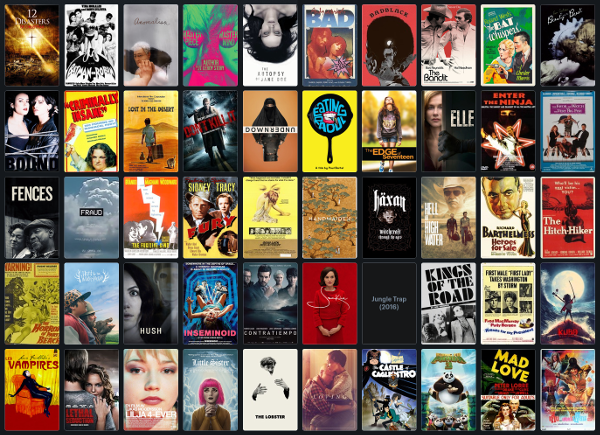
I saw a total of 1482 movies last year, and 1012 of those were films I’d never seen before. Rather than trying to come up with a top ten list for the year (although if I had to pick a favorite new release, it would probably be either Anomalisa or Hell or High Water), I just decided to provide a list of some of my favorite movies that I watched for the first time last year. So here’s the list (also available on Letterboxd):

The 12 Disasters of Christmas (2012) — The Mayans were right about 2012 being the end of the world, but they also knew how to stop it, and they ensured that knowledge would survive the end of their own civilization by encoding the secret in the Christmas carol “The 12 Days of Christmas”. Now Jacey, with the help of her parents Mary and Joseph, must use menstrual cramps to help her find five golden rings hidden around their small town of Calvary to stave off destruction.

Alyas Batman en Robin (1991) — One of the greatest possible results of the lax copyright laws of the Philippines, the Caped Crusader and his sidekick, sing, dance, and fight their way through nemeses like The Joker and The Penguin.

Anomalisa (2015) — An animated film about a man who sees everyone with the same face and hears everyone with the same voice. And then he encounters a woman with a different face and a different voice.

Author: The JT LeRoy Story (2016) — A documentary about a sensational young writer. It’s best to go into this one with as little knowledge as possible.

The Autopsy of Jane Doe (2016) — A father and son (Brian Cox and Emile Hirsch) spend a stormy night performing an autopsy on an unknown female.

Bad (aka Andy Warhol’s Bad; 1977) — A woman runs a combination beauty parlor, boarding house, and hitwoman service.

Bad Black (2016) — Made on a budget of hundreds of dollars and unlimited enthusiasm, this Ugandan action movie features a kid named Wesley Snipes who teaches a doctor to be a badass. The running commentary alone is worth ten times the price of admission.

The Bandit (2016) — A documentary about Burt Reynolds, Hal Needham, and the creation of Smokey and the Bandit.

The Bat Whispers (1930) — A master criminal has made a name for himself by announcing his thieving intentions to the police ahead of time and still pulling off the job. Then, he sets his sights on a mansion full of lots of interesting people.

Beauty and the Beast (1946) — Jean Cocteau directs what must be the definitive live-action version of this tale as old as time.

Bound (1996) — A former criminal (Gina Gershon) intends to make good, but that flies out the window when she falls for a woman (Jennifer Tilly) with a plan to steal from her mafioso boyfriend (Joe Pantoliano).

Criminally Insane (1975) — Ethel (Priscilla Alden) is an obese woman with a history of mental illness. People who try to get her to eat less tend to wind up dead.

Dirkie: Lost in the Desert (1969) — A young boy named Dirkie finds himself alone with his dog in the Kalahari Desert.

Don’t Kill It (2016) — In this Fallen meets It Follows kind of horror comedy, a demon hunter (Dolph Lundgren) must find a way to take out a demon that possesses whoever kills its previous host.

Down Under (2016) — A hilarious Australian comedy about two groups of idiots facing off against each other in a race war.

Eating Raoul (1982) — Paul Bartel and Mary Woronov star in this dark comedy about a couple who invite horny men to their apartment with the promise of sex, only to kill and rob them.

The Edge of Seventeen (2016) — An awkward, self-centered teenager (Hailee Steinfeld) hates the world, and she becomes even more incorrigible when her brother (Blake Jenner) starts dating her best friend (Haley Lu Richardson). Featuring a surprisingly good supporting performance by Woody Harrelson.

Elle (2016) — Isabelle Huppert plays a woman whose father is a serial killer, whose mother enjoys gallivanting with hot young men, and whose son is having a baby with his awful girlfriend. She also runs a video game company that is producing a highly sexualized game, and now she is a rape victim.

Enter the Ninja (1981) — An American veteran turned ninja (Franco Nero) learns that Filipino businessman (Christopher George) is intent on taking the farm of his war buddy (Alex Courtney, whose wife is played by Susan George).

The Favor, the Watch, and the Very Big Fish (1991) — Louis (Bob Hoskins) is a photographer who specializes in religious imagery. Sybil (Natasha Richardson) is a woman who does voiceover work in pornographic movies. Sybil tells Louis about a gifted pianist (Jeff Goldblum) who is about to be released from prison, and Louis hires him to portray Jesus in his photographs.

Fences (2016) — Denzel Washington plays a man who sees himself as fighting the good fight to provide for his family, but is in actuality one of the best villains of the year. But the real superstar of this film is Viola Davis, who provides what is unquestionably the greatest performance of 2016.

Fraud (2016) — A highly unique and mostly fictional narrative is seamlessly crafted from assorted YouTube clips.

The Fugitive Kind (1942) — A wanderer (Marlon Brando) finds his way into a small town and gets a job at a store run by a lonely woman whose cruel husband (and the store’s owner) is dying of cancer. Directed by Sidney Lumet, and featuring Joanne Woodward, Maureen Stapleton, and R.G. Armstrong.

Fury (1936) — A man (Spencer Tracy) is mistaken for a murderer while driving through a small town whose inhabitants decide to take matters into their own hands and carry out the execution themselves. But the man survives, and he wants revenge.

Good Luck, Miss Wyckoff (1979) — A white schoolteacher is raped by a black janitor, but then finds herself in a forbidden relationship with him. The impressive cast includes Donald Pleasence, Robert Vaughn, Earl Holliman, Ronee Blakley, Doris Roberts, R.C. Armstrong, and Dana Elcar.

The Handmaiden (2016) — A mischievous Korean girl agrees to help a con man win the hand (and fortune) of a wealthy Japanese woman, only to find that the situation is much more complicated than it first seemed. Another masterpiece from director Park Chan-wook.

Häxan (aka Witchcraft Through the Ages; 1922) — A Swedish silent film that depicts the history of witches and demons and other types of mystical folklore.

Hell or High Water (2016) — A pair of brothers (Chris Pine and Ben Foster) plan to rob several branches of a Texas bank with little regard for their clientele. Jeff Bridges is determined to stop them.

Heroes for Sale (1933) — A William Wellman film about a man who can’t catch a break. He was a war hero, but whose credit went to someone else, and who just ended up as a morphine addict unable to hold a job.

The Hitch-Hiker (1953) — A couple of guys on a fishing trip pick up a hitchhiker that turns out to be an escaped serial killer. Directed by Ida Lupino.

The Horror of Party Beach (1964) — A small beach town is terrorized by monsters created by radioactive waste. A scientist works to find a way to fight the monsters, with the help of his daughter and her boyfriend.

Hunt for the Wilderpeople (2016) — When a kid’s foster mom dies, the government wants to take him away from foster dad Sam Neill. The two take to the New Zealand bush to prevent that and become infamous in a The Legend of Billie Jean sort of way.

Hush (2016) — A deaf woman (Kate Siegel) must protect herself from a very determined home invader.

Inseminoid (1981) — When a woman exploring another planet is raped and impregnated by an alien, she starts killing her crewmates.

The Invisible Guest (2016) — A man wakes up in a locked hotel room with a dead body and desperately tries to prove that he’s not the murderer.

Jackie (2016) — Natalie Portman plays the widow of John F. Kennedy in the wake of his assassination.

Jungle Trap (2016) — Shot in the 1990s but only recently completed, James Bryan and Renee Harmon tell the story of people who travel to a haunted hotel in the jungle to get an artifact from a native tribe.

Kings of the Road (1976) — A Wim Wenders film about a man who runs a traveling movie theater, and a depressed man who hitches a ride with him for a while.

Kisses for My President (1964) — When Leslie McCloud (Polly Bergen) is elected the first female president of the United States, her husband (Fred MacMurray) becomes the first male First Lady. Also featuring Eli Wallach.

Kubo and the Two Strings (2016) — A boy with a magical storytelling ability must defend himself and his sick mother against her father and sisters.

Les Vampires (1915) — A seven-hour French silent film (originally released as a serial) about a reporter trying to expose a group of criminals that call themselves “The Vampires”.

Lethal Seduction (2015) — A talented high school student falls for an older woman (Dina Meyer), much to the chagrin of his mother (Amanda Detmer). And that’s before learning that the other woman is a jealous psychopath.

Lilya 4-Ever (2002) — A teenage orphan from Estonia goes to Sweden in the hopes of finding a new life for herself, only to be forced into service as a prostitute.

Little Sister (2016) — A woman in training to become a nun goes home to visit her family, and her goth past, when her injured brother comes home from military service. Featuring Ally Sheedy, Keith Paulson, and Barbara Crampton.

The Lobster (2015) — A dystopian future hotel provides a strong incentive for couples to find their soulmates: if you don’t find your match, you’ll be turned into an animal or hunted for sport. Featuring Colin Farrell, Rachel Weisz, John C. Reilly, Olivia Colman, and Léa Seydoux.

Loving (2016) — The true story of an interracial couple (Joel Edgerton and Ruth Negga) fights for the right to live together in Virginia, whose case went all the way to the Supreme Court.

Lupin the Third: The Castle of Cagliostro (1979) — A Studio Ghibli film about a master thief whose big haul turned out to be all counterfeit. He decides to go after the counterfeiters and rescue a damsel in distress in the process.

Kung Fu Panda 3 (2016) — A clumsy but pure-of-heart panda (Jack Black) must deal with meeting his real father and learning more about his roots while also squaring off against a supernatural villain from the spirit world.

Mad Love (1935) — A gifted surgeon (Peter Lorre) has a crush on an actress. When her pianist husband loses his hands in a train accident, the surgeon replaces them with hands from a recently-executed knife thrower.

Magic of Spell (1988) — A Taiwanese film about Peach Boy (obviously played by a girl) who must face off against a blood-consuming devil and his magical henchmen. So of course Peach Boy teams up with a bunch of hybrids, including a dog-girl, a monkey-boy, a chicken-girl, and a ginseng boy.

Manchester by the Sea (2016) — A man with a traumatic past must deal with the death of his brother and the son he left behind. Starring Casey Affleck and Michelle Williams.

Miss Sharon Jones! (2015) — A documentary about an R&B singer who must put her career on hold while she seeks treatment for pancreatic cancer.

Moonlight (2016) — A look at various stages in the life of a boy growing up in a rough neighborhood with a mother who is an addict, who is taken under the wing of a drug dealer, and who must confront his own sexuality.

The New 8-Bit Heroes (2016) — A documentary about the challenges of indie game development for the original Nintendo Entertainment System.

The Nice Guys (2016) — A Shane Black period crime drama comedy about a single-dad private investigator (Ryan Gosling) is hired to investigate the death of a porn star, which has also drawn the attention of another brutish detective (Russell Crowe).

The Novack Murders (aka Beautiful & Twisted; 2015) — A “based on a true story” Lifetime drama about Ben Novack Jr. (Rob Lowe), a wealthy hotel owner who is very into Batman. When he ends up dead, his wife (Paz Vega) is the prime suspect. Also featuring Candace Bergen.

Paperhouse (1988) — A girl has drawn a picture of a house, only to find that she can visit that house and that changes to the drawing adversely affect that house and the sick boy who lives in it.

Pee-wee’s Big Holiday (2016) — Pee-wee Herman ventures out of his small town for the first time after becoming fast friends with Joe Manganiello and being invited to New York for his birthday party.

Pete’s Dragon (2016) — A car accident orphans a young boy named Pete in the woods, where he is found and raised by a dragon with the ability to become invisible. Pete is found by a forest ranger (Bryce Dallas Howard) whose father (Robert Redford) claims to have had his own brush with the dragon.

Pippi in the South Seas (1970) — Pippi Longstocking enlists the help of her friends Tommy and Annika to help rescue her sea captain father from his pirate captors.

Presenting Princess Shaw (2015) — A documentary about a woman who uploads her homemade musical creations to YouTube, and a musician on the other side of the world who discovered her videos and decided to turn them into something much more polished.

The Quiet Earth (1985) — A scientist wakes up one morning to find the world devoid of people after an experiment gone horribly wrong. He eventually learns that he’s not the only survivor, but those few people who are left are still in imminent danger.

Raiders! The Story of the Greatest Fan Film Ever Made (2015) — A documentary about a couple of boys who loved Raiders of the Lost Ark so much that they spent years creating their own nearly-complete shot-for-shot version of the film. Decades later, they reunite to complete that one remaining scene.

Remember the Night (1940) — A prosecutor (Fred MacMurray) is concerned that he might lose a Christmastime shoplifting case, he’s able to get the trial postponed until the new year. But he feels guilty about leaving the defendant (Barbara Stanwyck) to sit in jail, so he bails her out only to find himself stuck with her for the holidays.

Road House (1948) — Night club owner Jefty (Richard Widmark) becomes jealous when singer Lily (Ida Lupino) falls for his best friend, and club manager, Pete (Cornel Wilde). Jefty gets his revenge by framing Pete for robbery and turning him into his indentured servant.

Road to Salina (1970) — When a drifter (Robert Walker, Jr.) wanders into a remote gas station/restaurant, its owner (Rita Hayworth) mistakes him for her long-lost son, and the man indulges her fantasy. Also featuring Ed Begley and Mimsy Farmer.

S Is for Stanley (2016) — When an aspiring Italian racecar driver drove a taxi to make ends meet, he was hired to transport a giant phallus across London in a blizzard to a movie set. Thus began the thirty-year working relationship between Emilio D’Alessandro and Stanley Kubrick, and thus begins this thoroughly charming documentary about one of the greatest directors of all time from the perspective of the man who would become his personal assistant.

Safe Neighborhood (2016) — A fun, brutal Christmas thriller in which a teenage girl must stave off a home invasion and the advances of the horny preteen boy she’s babysitting. Featuring Virginia Madsen and Patrick Warburton.

Snowmageddon (2011) — A snow globe shows up on a family’s doorstep just as a series of disasters plague the small town of Normal, Alaska. Inside the globe is a model of the town, and whatever misfortunes befall that model also affect the town.

Southside with You (2016) — A dramatization of Barack Obama’s first date with wife-to-be Michelle.

Stroszek (1977) — Werner Herzog’s film about a lovable German alcoholic who decides to accompany a battered prostitute and an elderly man to travel to America to make a new life for themselves, only to find that it’s not quite the land of opportunity they had hoped.

Taxi (aka Taxi Tehran; 2015) — Filmmaker Jafar Panahi may have been banned from making movies by the Iranian government, but he circumvents that by posing as a taxi driver and turning his car into a studio to create a very candid film about life in the oppressive country.

Three Colors: Blue (1993) — Juliette Binoche stars as a woman who survives the car accident that killed her famous composer husband and their daughter, only to learn that her husband also left behind a pregnant mistress.

Three Colors: Red (1994) — A woman accidentally runs over a dog that belongs to a retired judge. When she tries to return the dog, she learns that the man is secretly spying on and recording the private conversations of everyone around him.

Three Colors: White (1994) — A Polish man living in France is forced into poverty when his marriage is dissolved for his inability to consummate. He enlists the help of a friend to make his way back into Poland.

Tickled (2016) — A journalist discovers the underground world of online tickling competitions and starts digging to see if he can find more about its origins.

Tower (2016) — It’s been fifty years since a sniper took up a position at the top of the University of Texas tower. This documentary features dramatized interviews with those who were there and rotoscoped recreations of the events of the day.

Under the Shadow (2016) — Being a woman in Iran is already a pretty horrifying experience, but things get worse when her home is invaded by a supernatural force.

The Uninvited (1988) — A man (Alex Cord) plans to sail his yacht to the Cayman Islands to withdraw his ill-gotten funds before they can be seized by the government, with the help of his henchmen (George Kennedy and Clu Gulager). But the crew find themselves in mortal danger from a radioactive cat escaped from a research facility.

Wendy and Lucy (2008) — An unemployed young woman named Wendy (Michelle Williams) is traveling to Alaska with her dog Lucy in the hopes of finding a job. When Wendy is detained for attempting to shoplift, Lucy goes missing.

The Young Offenders (2016) — A pair of young Irish lads with a penchant for ticking off the police embark on a cross-country bike trip in the hopes of getting their hands on a multi-million-Euro brick of cocaine that had been lost in a boat accident.

Zootopia (2016) — In a world where animals have learned to live together in peace, a young, ambitious bunny stumbles on a plot to return predators to their violent roots.

Neil’s Underrated ’85 Picks

Stone Pillow

US Release: November 1985

Lucille Ball had been in over 40 movies before her first television appearance, but it’s TV that really made her a star. So it’s fitting that her final movie role would be this made-for-TV drama in which she plays Flora, a jaded, feisty, no-nonsense homeless woman who knows all the tricks needed to survive the New York City streets. Daphne Zuniga is Carrie, a naive, fresh-out-of-college girl struggling in her job at a homeless shelter. While out on a fact-finding mission to try to better understand the homeless, Carrie encounters Flora just in time for both of them to get mugged. Mistaking her for a runaway, Flora grudgingly takes Carrie under her wing to gives her a first-hand look at what it’s like to live on the streets.

Stone Pillow is a far cry from the comedy roles that made her famous, and her trademark red is completely gray, but you can’t help but recognize Ball’s voice as she completely owns this movie. It’s a captivating drama that manages to be an effective social commentary without feeling awkward or heavy-handed. Zuniga does a fine job in her supporting role that thankfully takes a back seat to Lucy’s lead, and I was pleasantly surprised to see Mike Starr make an uncredited appearance.find an uncredited appearance from Mike Starr.

Poison Ivy

US Release: February 1985

Summer camp movies are one of mankind’s greatest inventions, right up there with electricity and the wheel. And Poison Ivy has to be one of the best summer camp movies ever made. It’s not that there’s anything all that unusual or innovative about it, but it’s just done really wellThere’s not really anything all that unusual about it, but it’s just done really well. There are the usual camper stereotypes, like the athlete, the fat kid, the nerd, the smoothfast-talking con manartist, and the runaway, but there’s more depth to their characters than you might find in one of the lesser movies. Michael J. Fox (probably mostly known for Family Ties at this point, since Back to the Future and Teen Wolf wouldn’t hit theaters for another few months) is the big star, as noted by his appearing no fewer than four times on the VHS cover art, but Nancy McKeon (The Facts of Life) has the more nuanced role as the assistant nurse who is attractive and draws the attention of many of males of varying ages but isn’t merely is much more than a sex symbol. On the other hand, Adam Baldwin’s “head counselor with a stick up his ass” role does seem pretty one-dimensional, and Robert Klein’s camp director gives a few enthusiastic speeches but is otherwise pretty insignificant. Despite a fairly prominent credit on the VHS cover, Jason Bateman is nowhere to be found in the movie.

At times, Poison Ivy feels a lot like a younger and tamer version of Revenge of the Nerds. Many of the campers are misfits but they mesh well together, and the camp’s big “color wars” competition a lot in common with the Greek Games. It also reminds me of the 1990 “who’s who of network television” movie Camp Cucamonga, which makes sense because Bennett Tramer wrote them both (along with a fair amount of Saved by the Bell). Poison Ivy is probably familiar because it doesn’t do much that hadn’t been done before, but it does it well and with a great dose of nostalgia to boot.

Heavenly Bodies

US Release: February 1985

Jane Fonda’s early 1980s workout videos made aerobics popular in the home, but it didn’t get much big-screen attention until Heavenly Bodies. It features Cynthia Dale as Samantha, who manages to escape her boring day job and join up with friends KC and Patty to turn a dilapidated warehouse into an aerobics studio. Sam’s upbeat attitude and nonstop energy help to quickly grow the membership, and she even signs a deal with the local pro football team to whip their players into shape (and gets a love interest in the process). Things really take off when Samantha lands a gig hosting an early-morning workout show on TV, but that doesn’t sit well with Debbie, the girlfriend of a rival gym owner who thought she had the TV show locked up. When Debbie convinces an investor to buy the Heavenly Bodies building and terminate their lease, Samantha does a little Network-style rant on her show and challenges the other gym to a marathon aerobics competition for the building.

In defiance of all known laws of mathematics, this movie is approximately 150% montage. There are three separate montages (Samantha at her old job, fixing up the building, and doing aerobics with ever-increasing class sizes) before we encounter a scene with any substantial dialogue. You won’t find any needless exposition here, and it’s practically a master class in “show don’t tell” filmmaking. It’s cheesy at times, motivations aren’t always clear, and it’s unlikely to inspire anyone to get off their butt and start exercising, but it is a movie that’s fun to watch and even stands up well under repeat viewings.

The Party Animal

US Release: January 1985

More than a decade before VH-1 ran its Where Are They Now? series, The Party Animal somehow managed to spoof it. It’s a documentary-style look back at the college career of Pondo Sinatra, a guy with only sex on the brain but thus far a complete lack of experience. His experienced roommate Studly agrees to help him, but his efforts (like a wardrobe makeover and an utterly ridiculous Cyrano de Bergerac sequence) just don’t seem to pan out. Even Studly’s mentor Elbow can’t seem to get him over the hump. It’s only when a professor makes a reference to an aphrodisiac in a lecture that Pondo’s luck begins to change.

There is nothing subtle about this movie. It’s more about quantity than quality, and while some of the gags miss the mark badly (like an uncomfortably racist scene, or a drug sequence that goes on too long without much payoff), a lot of them work. It’s not as classy as your higher-brow sex comedies like Porky’s or The Last American Virgin, but it’s also willing to venture into territory that other movies wouldn’t dream of touching (e.g., a scene in a sex shop where Pondo browses while a couple of employees have a conversation on arms reduction in the voice of Marlon Brando). The premise may have been done to death, but there’s stuff in The Party Animal you won’t find anywhere else.

The Perils of Gwendoline in the Land of the Yik Yak

US Release: January 1985

In one of the most ridiculous of the Indiana Jones clones, Tawny Kitaen plays the titular Gwendoline. She’s looking for her father, who never came back from a mission to find a rare butterfly. For some reason, she latches onto a guy named Willard (who has about as much charm and machismo as you’d expect from someone with that name) and finagles him into being her guide on a mission to find out what happened. And despite learning almost immediately that her father is dead, they set off into dangerous territory to try to figure out exactly what happened and to find that elusive butterfly.

This is really just a boob delivery mechanism masquerading as an action-adventure film, and it accomplishes that quite effectively if not brilliantly. A jungle storm necessitates disrobing to fashion a means of capturing the rainwater. A cold night spent tied up by superstitious natives requires what basically amounts to phone sex in order to keep warm. And the final act takes place in a no-boys-allowed hidden city that is kind of a sexy Coliseum of topless chariot racing and hand-to-hand combat. This isn’t the place to look for classy, edge-of-your-seat excitement, but few movies deliver trashy over-the-top absurdity as well as this one.

The Movies I Watched in 2014

As per usual, I watched a lot of movies in 2014.  In fact, it seems I watched even more movies in 2014 than I did any previous year.  There have been years in which I’ve seen more in theaters, and there have been years in which I’ve seen more outside of theaters, but this year the combination of the two is higher than in any previous year.
Here’s a quick rundown of some statistics:

  • I watched a total of 1785 movies over the course of the year.  765 of those were at a theater, and 1020 of those were outside of a theater.
  • 613 (80.01%) of the in-theater movies were at an Alamo Drafthouse, and 130 (16.99%) were presented by the Austin Film Society.  20 (2.61%) were at the Violet Crown, and 2 (0.26%) at the Regal Arbor Cinema.
  • 451 (58.95%) of theatrical screenings were movies I’d never seen before, as compared with 314 repeat watches.  538 (70.33%) of in-theater movies were repertory screenings versus 227 new releases.
  • All but two new release screenings were digital; Interstellar was the only new release I saw on film, and I saw it in both 70mm and 35mm formats.  However, repertory screenings were a goldmine of honest-to-goodness film presentations, with a whopping 74.04% of repertory screenings on 35mm, 70mm, or 16mm film, rather than digital.  Note that this doesn’t count 33 theatrical presentations of movies on VHS, since they are neither film nor digital.
  • I did not see any movies in 3D over the course of the year.  However, I did see two films that contained 3D scenes.  The 1962 British sci-fi comedy Paradisio uses 3D for scenes in which the protagonist wears X-ray glasses, and the 1991 horror movie Freddy’s Dead:  The Final Nightmare has a few minutes of 3D for a scene in a dream world.  Both were theatrical screenings of 35mm prints.
  • Of the 1020 movies I watched outside of a theater, 438 (42.94%) were watched on physical media (DVD, Blu-ray, VHS, or Beta), as compared with 582 movies legally streamed (from Amazon, YouTube/Google Play, Vimeo, VHX, and UltraViolet).  I did not watch any movies via any kind of television service, nor did I watch any illegally-downloaded movies.
  • 684 (67.06%) of the non-theatrical movies were first-time watches, versus 336 movies that I had seen at least once before.

The Best Big New Releases

A disappointing number of top ten lists that I’ve seen from critics seem to have an inordinately large focus on big Hollywood releases.  I suppose those are the movies that most people tend to watch, but it’s hard to consider them the best or most enjoyable movies of the year.  Nevertheless, if I were to pick the best movies out of those that I consider “big” releases, they would be:

    1. Snowpiercer (at least, it had a $40M budget and was big outside the US)
    2. Big Hero 6
    3. The Lego Movie
    4. Guardians of the Galaxy
    5. Captain America 2:  The Winter Soldier
    6. Edge of Tomorrow
    7. Oculus
    8. Interstellar
    9. Dumb and Dumber To
    10. Neighbors

The Real Best New Releases

In all honesty, I have a hard time buying any list of best movies from a professional film critic that is mostly comprised of mainstream movies.  Here is my real “best of” list for 2014 releases, expanded to 20 so that I can fit in more really great movies:

  1. Boyhood
  2. Big Bad Wolves
  3. Blue Ruin
  4. Snowpiercer
  5. Joe
  6. The Drop
  7. Grand Piano
  8. Locke
  9. August: Osage County
  10. Citizenfour
  11. Under the Skin
  12. The Great Beauty
  13. The Overnighters
  14. Whitewash
  15. That Guy Dick Miller
  16. Life Itself
  17. Ernest & Celestine
  18. Housebound
  19. To Be Takei
  20. Nightcrawler

Movies To Watch For

Over the course of the year, I had the opportunity to see movies that either haven’t been released yet or about which I’m uncertain about their American release status.  At any rate, if you have the opportunity to see any of these movies, you should take it.

  • Arlo and Julie
  • Bob Birdnow’s Remarkable Tale of Human Survival and the Transcendence of Self
  • Electric Boogaloo
  • Goodnight Mommy
  • Haemoo
  • Intramural
  • Kung Fu Elliot
  • Man from Reno
  • Shrew’s Nest
  • The Treatment
  • Wicker Kittens
  • Wyrmwood

The New Releases Everyone Seems to Be Wrong About

These are movies I’ve seen people rave about in a manner that seems completely unjustified and may be a sign of mass delusion:

  • 20,000 Days on Earth
  • The Boxtrolls
  • Chef
  • Dawn of the Planet of the Apes
  • Dear White People
  • The Immigrant
  • Jodorowsky’s Dune
  • The Raid 2
  • Rich Hill
  • Top Five
  • The Trip to Italy
  • Whiplash

My Favorite Theatrical Marathons / Movie Series

One of the best things about the amazing film programming in Austin is that it often results in movie marathons (several movies in a day) or film series (several movies spread out over a period of days or weeks) that are centered around some actor, director, or theme.
There are a number of regular Drafthouse film series that deserve recognition, including Terror Tuesday, Weird Wednesday, Video Vortex, Cinema Cocktails, and Master Pancake Theater, along with the AFS Essential Cinema, History of Television, and Savage Gold series.  These are ongoing, long-term series that are always great, expertly curated, and entertainingly introduced.  But for this section I want to focus primarily on one-time events, and these are some of my favorites from 2014:

  1. The Drafthouse “Waltered States” Walter Matthau marathon.  I’m clearly biased here, because this is one that I got to program.  I’ve wanted to do a Walter Matthau marathon for about as long as I’ve known that movie marathons were a thing, and this year I got the chance.  I showed The Fortune Cookie, Cactus Flower, Fail-Safe, The Bad News Bears, and Charley Varrick.
  2. The Drafthouse Police Academy marathon.  All seven Police Academy movies on the big screen (although only parts 3, 4, 5, and 7 were in 35mm).  I legitimately love all of these movies (well, maybe not Mission to Moscow) and never thought I’d have the chance to see them in a theatrical marathon.
  3. The AFS Essential Cinema month of Barbara Stanwyck films, including The Lady Eve, Internes Can’t Take Money, Lady of Burlesque, and Ball of Fire.  That last one became one of my favorite comedies ever.
  4. The AFS “Savage Gold” marathon.  Savage Gold is a regular AFS series in which Lars Nilsen and Max Meehan team up to provide an amazing double feature of obscure VHS movies.  But they outdid themselves when they teamed up with Zack Carlson for an all-night, six-movie marathon of Don’t Go Near the Park, Beyond the Doors, Lady Street Fighter, Bad Girls Dormitory, Final Score, and D.T. in “Dawg Territory”.
  5. The AFS “Jewels in the Wasteland” series.  Richard Linklater selected a number of great and often obscure films from the years 1980 through 1983.  He and Lars Nilsen introduced each of the films and led a discussion afterward.  Scheduling conflicts sadly prevented me from seeing Veronika Voss, Reds, and Out of the Blue, but I did get to attend The King of Comedy, Valley Girl, White Dog, Melvin and Howard, Every Man for Himself, Star 80, Das Boot, Cutter’s Way, Fanny & Alexander, Rumble Fish, and Atlantic City.
  6. The Drafthouse “Noir City” series, in which film noir preservationist Eddie Muller presented 35mm prints of a number of great noir films.  The lineup included Too Late for Tears, Try and Get Me, Larceny, Crashout, Cry Danger, The Breaking Point, Repeat Performance, Three Strangers, Alias Nick Beal, and The Chase.  Many of these films aren’t available except for the prints restored and maintained by the Film Noir Foundation.
  7. The AFS Old-School Kung-Fu Weekend.  This has apparently become an annual event, in which kung fu film expert Dan Halstead selects a number of films to screen.  This year’s selections included:  Shaolin vs Lama, The Kid with the Golden Arm, Master of the Flying Guillotine, 7 Grandmasters, The 36th Chamber of Shaolin, and The Man from Hong Kong.
  8. The AFS “Godard vs Truffaut” series, in which Lars Nilsen picked four films by Jean-Luc Godard (Breathless, Pierrot Le Fou, Week End, and A Woman Is a Woman) and Chale Nafus picked four from François Truffaut (the Antoine Doinel series of The 400 Blows, Antoine et Collette + Stolen Kisses, Bed and Board, and Love on the Run).  Lars and Chale alternated weeks and tried to make a case for their respective filmmaker.  Sorry, Lars, but I have to side with Chale on this one.
  9. The Drafthouse “Caged” Nicolas Cage marathon, consisting of Vampire’s Kiss, Leaving Las Vegas, Fire Birds, Con Air, and Raising Arizona.  I’d never seen Fire Birds before, but I absolutely loved it, and I never thought I’d get to see Vampire’s Kiss in a theater.  And it looks like this may be an annual event, since “Caged 2” is happening the first weekend of 2015.
  10. The Drafthouse “Merylthon” Meryl Streep marathon, conceived by a number of Drafthouse servers while working the aforementioned “Caged” marathon.  They went on to select and introduce the films for the marathon, which turned out to be Postcards from the Edge, Sophie’s Choice, The River Wild, The Iron Lady, and Death Becomes Her.

Even if they didn’t make the top ten, I should at least give honorable mentions to:

  • The Drafthouse David Lynch influences series (Rear Window, Lolita, Mon Oncle, Peyton Place, Sunset Blvd., and Hour of the Wolf)
  • The Drafthouse “Dismember the Alamo” horror marathon (TerrorVision, House of Dracula, Ernest Scared Stupid, and Killer Klowns from Outer Space)
  • The Drafthouse / AGFA Cinemapocalypse marathon (Heat, Raggedy Ann & Andy: A Musical Adventure, The Miss Nude America Contest, Lolly Madonna XXX, and Miami Blues)
  • The Drafthouse Something Weird marathon (Blood Feast; Pot, Parents, and Police; A Pistol for Ringo; Man or Woman; and Crazed Vampires)
  • The Drafthouse Marx Brothers retrospective
  • The Drafthouse Back to the Future marathon
  • The AFS Roger Corman series (A Bucket of Blood, Pit and the Pendulum, X:  The Man with X-Ray Eyes, and Gas-s-s-s)
  • The AFS Arthouse Horror series (Possession, Kwaidan, Amuck, and Hausu)
  • The Drafthouse Dirty Harry marathon
  • The Drafthouse “East Meets Weird” Asian film marathon (Killers on Parade, The Aimed School, Goke: Body Snatcher from Hell, The Happiness of the Katakuris, and Why Don’t You Play in Hell?)

My Favorite Individual Theatrical Repertory Movie Screenings

There were so many amazing repertory screenings over the course of the year that I feel it’s important to call special attention to some of my favorites:

  1. Ernest Goes to Camp.  There is no movie I have seen more often than this one in my life, but I had never seen it in a theater until this year, and at a screening with director John Cherry no less.  My deep affection for this movie began in my childhood but hasn’t wavered a bit over the years.
  2. Scream for Help.  I only discovered this movie earlier this year during my 1984 project (as described below), but I instantly fell in love with it and wanted to see it with an audience.  As if by divine inspiration, Max Meehan shares my love for this movie and picked it for the most recent iteration of Savage Gold.
  3. Scenes from a Marriage.  There is no possible way that a three-hour Swedish film, predominantly comprised of scenes with the same two people in unremarkable settings with virtually no action, can be this riveting.  I still need to watch the original five-hour miniseries from which the theatrical version was edited, but I am in awe.
  4. All that Heaven Allows.  This one took me completely by surprise.  A 1955 romance in which a woman faces life as a social pariah if she allows herself to fall for lower-class gardener.  It’s a seemingly-ridiculous premise, but it’s played with such immense gravity that it becomes utterly enthralling.  Plus, the movie just has an amazing look to it.
  5. Glengarry Glen Ross.  I’d seen this before, but never on the big screen.  It’s simply amazing.
  6. Crimewave (aka The Big Crime Wave).  I’d heard some friends raving about this obscure Canadian comedy about a writer who can’t seem to write the middle parts of stories, so I got it on VHS and really liked it.  Then, it was impossibly given a digital restoration that made it look so amazing and in the right aspect ratio and it got even better.
  7. Corn’s-a-Poppin’.  This is an hour-long film commissioned by the owner of a small theater chain who happened to be the brother of some popcorn bigwig and wanted to promote eating popcorn in movie theaters.  So he hired some people who made industrial films for a living and created an amazing piece of work that would be completely lost if it hadn’t been for the fact that one of the writers was a young Robert Altman.  It’s a shame that it’s still virtually inaccessible to most people, since it seems that the only way you can watch it is to get the only 35mm print in existence.  It’s thoroughly entertaining and seems to be making the rounds so maybe there’s hope for some kind of wider availability in the future.
  8. Targets.  I came across this Bogdanovich-directed, Corman-produced, Karloff-starring mishmash of a film a couple of years ago and was immediately taken by it, especially after watching the DVD featurette describing how it came to be.  I was ecstatic about getting a chance to see it on the big screen this year, and I was not let down.
  9. Top Hat.  I’d never seen this Fred Astaire / Ginger Rogers dance-filled musical comedy before this year, but it is stunning.
  10. City Lights.  Is this the best Chaplin film?  It’s certainly way up there.  In a year that I also got to see him on the big screen in The Gold Rush and The Circus, I’d have to say that City Lights outshines both of them.  It’s darn near cinematic perfection.

The Best Lesser-Known Movies from 1984

It’s an indisputable fact that 1984 was just about the best year ever for movies.  You are probably familiar with the “big name” releases for that year, including:

  • Bachelor Party
  • Beverly Hills Cop
  • Children of the Corn
  • Ghostbusters
  • Gremlins
  • Friday the 13th part IV:  The Final Chapter
  • Footloose
  • Indiana Jones and the Temple of Doom
  • The Karate Kid
  • The Last Starfighter
  • The Muppets Take Manhattan
  • The Natural
  • The Neverending Story
  • A Nightmare on Elm Street
  • Police Academy
  • Red Dawn
  • Repo Man
  • Revenge of the Nerds
  • Sixteen Candles
  • Splash
  • Star Trek III:  The Search for Spock
  • The Terminator
  • This Is Spinal Tap
  • Top Secret!

Given that this year was the 30th anniversary for all movies released in the year 1984, I wanted to try to see how many of these movies I could find.  I started with a list of 145 movies and ended up watching 365 (with quite a few more I didn’t get to).  Along the way I revisited a lot of great films and made a lot of amazing new discoveries.
I have no idea what you’ve seen and what you haven’t, so I won’t try to make one of those “best movies you haven’t seen” lists.  But here is a list of what I consider the top 84 lesser-known movies from the year 1984 (listed alphabetically, since I don’t want to try to rank them):

  • Alley Cat
  • Angel
  • Baby Love (aka Lemon Popsicle 5)
  • The Bear
  • Birdy
  • Black Devil Doll from Hell
  • Blame It on Rio
  • Blastfighter
  • Blind Date
  • The Boy Who Loved Trolls
  • Breakin’
  • Breakin’ 2:  Electric Boogaloo
  • Breakin’ in the USA
  • Breakin’ Through
  • A Breed Apart
  • The Brother from Another Planet
  • The Buddy System
  • The Cartier Affair
  • City Killer
  • Cloak & Dagger
  • Contract for Life:  The S.A.D.D. Story
  • The Census Taker
  • Delta Pi (aka Mugsy’s Girls)
  • Dreamscape
  • The Dungeonmaster (aka Ragewar)
  • Eight Diagram Pole Fighter
  • Electric Dreams
  • Ernie Kovacs:  Between the Laughter
  • Eureka
  • The Fantastic World of D.C. Collins
  • Fatal Vision
  • Firestarter
  • Firstborn
  • The Flamingo Kid
  • Flashpoint
  • Furious
  • Gone are the Dayes
  • The Goodbye People
  • Harry and Son
  • Hell Riders
  • The Hotel New Hampshire
  • Ice Pirates
  • The Jesse Owens Story
  • Just the Way You Are
  • Lace
  • The Lonely Guy
  • License to Kill
  • Mass Appeal
  • A Matter of Sex
  • Mister Roberts
  • Monaco Forever
  • My Mother’s Secret Life
  • Night of the Comet
  • The Night They Saved Christmas
  • Ninja III:  The Domination
  • Nothing Lasts Forever
  • Octavia
  • Oddballs
  • Over the Brooklyn Bridge
  • The Ratings Game (aka The Mogul)
  • The Return of Captain Invincible
  • The River Rat
  • Runaway
  • Sam’s Son:  Michael Landon’s Story
  • Savage Streets
  • Scream for Help
  • Second Time Lucky
  • Secrets of a Married Man
  • Silent Night, Deadly Night
  • The Sky’s No Limit
  • A Soldier’s Story
  • Starman
  • The Stone Boy
  • Stranger than Paradise
  • Streets of Fire
  • Suburbia
  • Surf II
  • Swing Shift
  • Teachers
  • The Toughest Man in the World
  • Vamping
  • Voyage of the Rock Aliens
  • Wet Gold
  • The Wild Beasts

My Favorite New Discoveries Not from 2014 or 1984

Believe it or not, I also watched a fair number of movies released in years other than 2014 or 1984.  Many of them were rewatches of movies I’d already seen, but I also got to see a lot of movies for the first time.  Some of my favorite new discoveries include:

  • All That Heaven Allows
  • All the Marbles
  • Atlantic City
  • Ball of Fire
  • Cisco Pike
  • Corn’s-a-Poppin’
  • Demon Seed
  • Disaster on the Coastliner
  • The Egg and I
  • Enter Nowhere
  • Fire Birds
  • Flesh Eater
  • Four Frightened People
  • Laura
  • Lonely Are the Brave
  • Marooned
  • On the Right Track
  • Phantom of the Mall:  Eric’s Revenge
  • Play Misty for Me
  • Polk County Pot Plane
  • Repeat Performance
  • The Russians Are Coming, The Russians Are Coming
  • Scenes from a Marriage
  • Straight Time
  • The Telephone Book
  • That Man from Rio
  • Too Late for Tears
  • Top Hat
  • What Ever Happened to Aunt Alice?
  • White Dog

Fruitvale Station

Being a police officer must be a pretty crappy job. Not only would you have to deal with horrible people and dangerous situations on a regular basis, but you’d probably also be disliked by a substantial portion of the population. The idea of the corrupt cop is a popular one in movies and on television, but it certainly has a basis in real life. If it seems that there is a higher incidence of police misconduct now than in the past, that may well be a direct result of a much greater percentage of the population carrying around cameras and the ease with which pictures and videos can be shared and re-shared. An ordinary traffic stop in a crowded area can yield more footage than the Kennedy assassination, and if an officer gets out of line, it’s no longer a matter of whose testimony is more believable.

Hopefully this “always being watched” mindset will benefit all of us by keeping the police honest and in turn improving the public opinion of them, or at the very least by getting the bad ones off the street. But in order for this to work, bad things have to happen to people, and Oscar Grant (portrayed by Michael B. Jordan) was one of those people. On one hand, he wasn’t always the most stand-up guy: he’d sold drugs and gone to jail; he’d cheated on his girlfriend; he’d gotten fired for repeatedly failing to show up for work on time. But on the other hand, he was trying to get better: he’d stopped selling drugs; he’d stopped cheating on his girlfriend; he loved his daughter very much and took a very active role in raising her. And he certainly didn’t deserve the treatment he received from transit police over-responding to an incident on the metro.

This is a powerful film enhanced by its great performances. Jordan is a key part of this, but so too is Melonie Diaz (as his girlfriend), Octavia Spencer (as Oscar’s mother), and Ariana Neal (his daughter). The film is based on a true story, although it’s not always clear how far they stray from what really happened. At times they paint what feels like an excessively flowery picture of racial harmony and civil behavior, to the extent that a drug deal gone wrong feels like it could have ended with the buyer and seller hugging it out. But this is done so well and provides such a stark contrast to the darker elements of the movie that I’m happy to believe that’s the way things really happened.

Pacific Rim

I was absolutely determined to love Pacific Rim. So far this summer has brought a lot of disappointment from Hollywood, and at this point I need to see something that proves that someone around there still knows what they’re doing. I’d heard almost universal praise from people who’d gone to preview screenings, so I took the risk of getting my hopes up. It’ll probably be a while before I let that happen again.

The premise is very simple: there’s some kind of atomic wormhole that links an alien world with a gash in the bottom of the ocean, and every so often a big creature called a Kaiju emerges from it and causes a whole lot of destruction until the humans can manage to kill it. At first, that was done with the traditional military weaponry, but when that proved inefficient, mankind created giant robots called Jaegers to fight the giant aliens. The robots are too complex to be controlled by a single person, so each of them needs two people with their brains linked together so that they do exactly the same thing at exactly the same time, and the robot mimics their actions.

Logic and creativity were apparently in extremely short supply when they were designing these robots because they are so obviously not the right tools for the job. They look something like huge versions of the Halo soldiers, which means they have roughly the same shape as humans, with arms, legs, a torso and a head. It doesn’t seem to matter that the head serves no apparent purpose, or that standing on two legs doesn’t provide very good speed or balance, or that maybe slow punches are a really crappy way to inflict damage. I would’ve expected that, with the world at stake, people might have started thinking outside the box and tried to come up with something that’s actually good at fighting the monsters. But they’ve only got two nerds and they’re too busy being annoying one-dimensional stereotypes to contribute much to the effort, and the best idea that the rest of humanity can come up with is to build a big wall around everything.

The movie is obviously based on the classic Japanese monster movies made popular in the 1950s but without any understanding of what makes them fun. It’s true that, like the older movies,

Pacific Rim

has horrible acting and cringe-worthy dialogue, but that’s not the secret. Certainly all of the CGI makes the new movie look flashier than the old ones featuring a guy in a rubber suit, but that also doesn’t do anything to add to the enjoyment. In fact, it’s pretty hypocritical for the movie to repeatedly stresses the classical approach may have something to offer over the new hotness, and then to subject us to nothing but pixels fighting pixels.

Clearly what this movie is really missing is the heart. It just doesn’t seem like the people involved really cared about trying to make a good movie. Perhaps it’s because most of the actors are predominantly involved with television and couldn’t adjust to a feature film. Maybe it’s that just about everything that happens is stolen from some other movie where it was done better (well, except maybe for the stuff they lifted from Avatar) so there’s nothing we haven’t seen before. I expected much better from Guillermo del Toro, but honestly I would have expected better from just about anyone.